

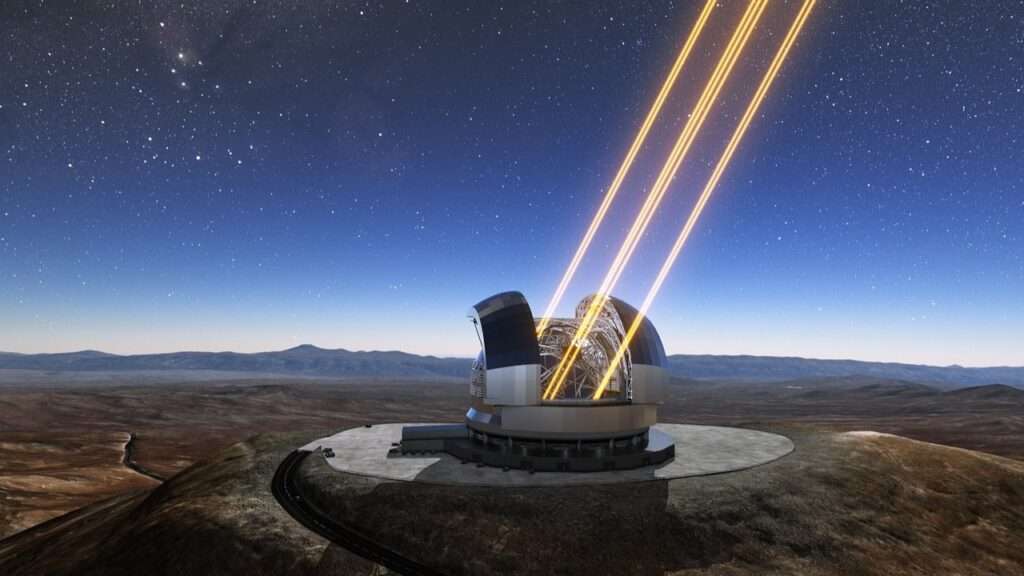
Amid the almost surreal landscape of Chile’s Atacama Desert, one of the most ambitious scientific instruments ever built is taking shape. It is called the Extremely Large Telescope (ELT) and promises to allow humanity to observe the Universe with a level of detail never before achieved from Earth, according to the BBC.
Rising atop Cerro Armazones, in one of the driest and most remote regions on the planet, the giant observatory will feature a dome approximately 80 metres high and a primary mirror 39 metres in diameter. The mirror will consist of 798 carefully manufactured segments, aligned with extraordinary precision.

The project is being developed by the European Southern Observatory (ESO), an international consortium of European countries dedicated to astronomical research. The outer structure is expected to be completed in 2027, with the telescope scheduled to begin scientific observations around 2030.
But size is not the only remarkable feature. The ELT’s capabilities could allow scientists to study some of the oldest stars in the Milky Way, observe the centre of our galaxy in greater detail, investigate planets beyond the Solar System and analyse their atmospheres.
This is where one of its most fascinating possibilities lies: searching for signs of extraterrestrial life.
By detecting certain chemical combinations in the atmospheres of distant planets, astronomers may find clues pointing to processes compatible with the existence of life. This does not mean that the ELT will immediately discover extraterrestrial beings, but it could bring us closer to answering a question that has accompanied humanity for centuries: are we truly alone in the Universe?
In the extreme silence of the Atacama, surrounded by rocks, volcanoes and one of the clearest skies on Earth, a gigantic window is being built to help answer that question.