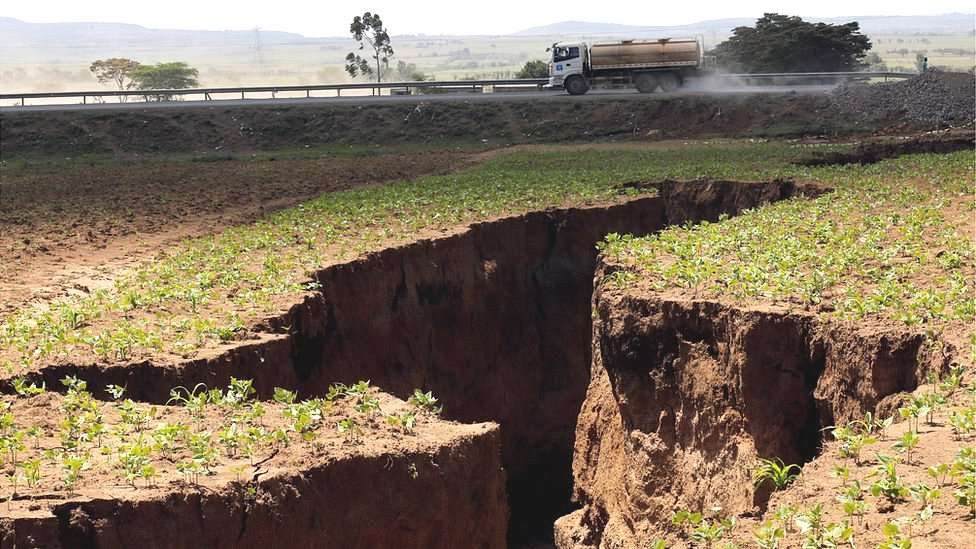

An international team of researchers has uncovered new evidence suggesting that the African continent may be entering the early stages of fragmentation in a previously understudied region. The discovery is based on the analysis of gases released from hot springs in the Kafue Rift, Zambia, which bear a chemical signature indicating they originated directly from the Earth’s mantle.
Scientists detected concentrations of primordial helium-3, a rare isotope that rises from deep within the Earth through geological faults. This geochemical evidence strengthens the hypothesis that the Kafue Rift is an early-stage continental rift and could eventually evolve into a new tectonic plate boundary.
The Kafue Rift forms part of a vast 2,500-kilometre-long rift zone stretching across Tanzania, Zambia and Namibia, with the possibility of extending as far as the Atlantic Ocean. Although the region experiences limited seismic activity and has no active volcanoes, geologists had already identified signs of tectonic activity, including gravity anomalies, elevated underground temperatures and deformation of the Earth’s crust.
According to Rūta Karolytė of the University of Oxford, quoted by New Scientist, it is rare to observe a rift system at such an early stage of development. Unlike the well-known East African Rift Valley—which extends from the Red Sea to Mozambique and has been evolving for tens of millions of years—the Kafue Rift could provide scientists with a unique opportunity to observe the birth of a future continental plate boundary.
For Patrice Rey of the University of Sydney, the new geochemical evidence makes it plausible that, over millions of years, this region could develop into a new tectonic plate boundary, gradually reshaping the geography of the African continent.