

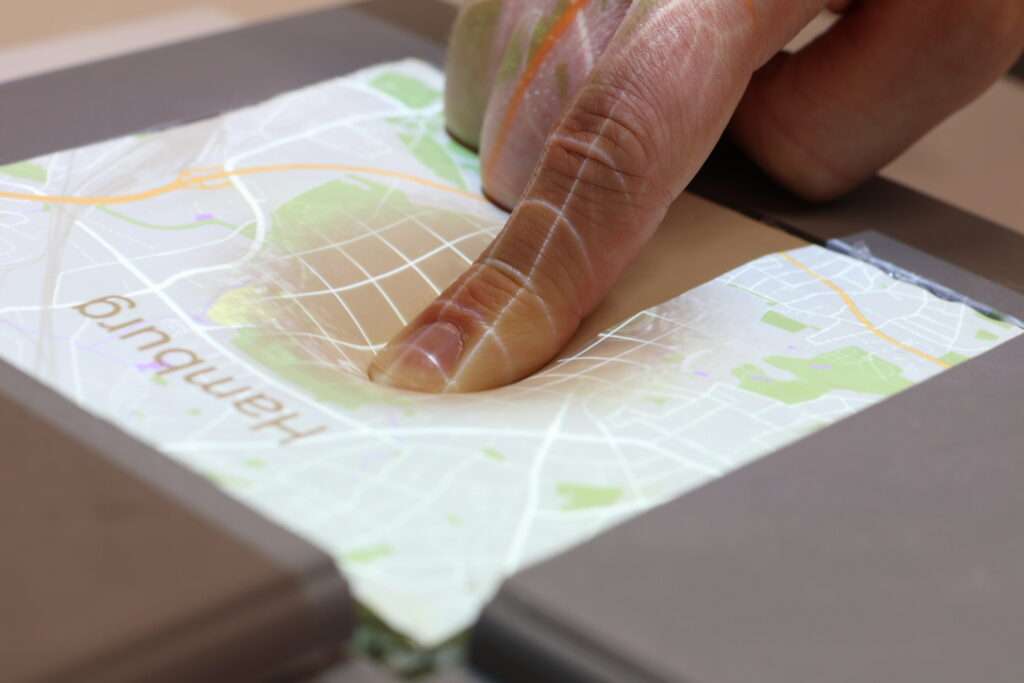
A touchscreen for digital devices that can be deformed by finger pressure, becoming softer or stiffer in direct response to the force applied by the user, has been developed by computer scientists at the University of Bath in the UK.
DeformIO – as it has been named – is still a prototype and will require at least a decade of further development before it can be transferred to technology companies to be turned into a commercial product; however, its inventors consider it to be an innovative technology.
They believe DeformIO has the potential to radically change the way people interact with the world in areas as diverse as commerce, communications, medicine and gaming.
Before making an online purchase, for example, the shopper of the future could be invited to ‘touch’ the fabric of a new sofa or ‘feel’ the softness of a cushion simply by pressing the display of the DeformIO phone.
The deformable screen also has the potential to change the way users interact with files and applications on their devices. To delete a file, for example, a person could press the file icon until it hardens and eventually ‘pops’ like a bubble.
‘You would be directly manipulating a digital object in the same way you would normally do with a physical object,’ explained James Nash, a postgraduate in computer science at Bath and first author of a study describing the new technology, published this month.
Although this is not the first iteration of a deformable screen, previous models (made of movable touchscreen panels or rigid pins) created a less continuous experience than DeformIO, relying on sets of raised ‘pins’ situated below the screen which, when pressed, lowered a section of the screen. This technology results in sudden breaks or steps between areas of the screen when pressure is applied.