
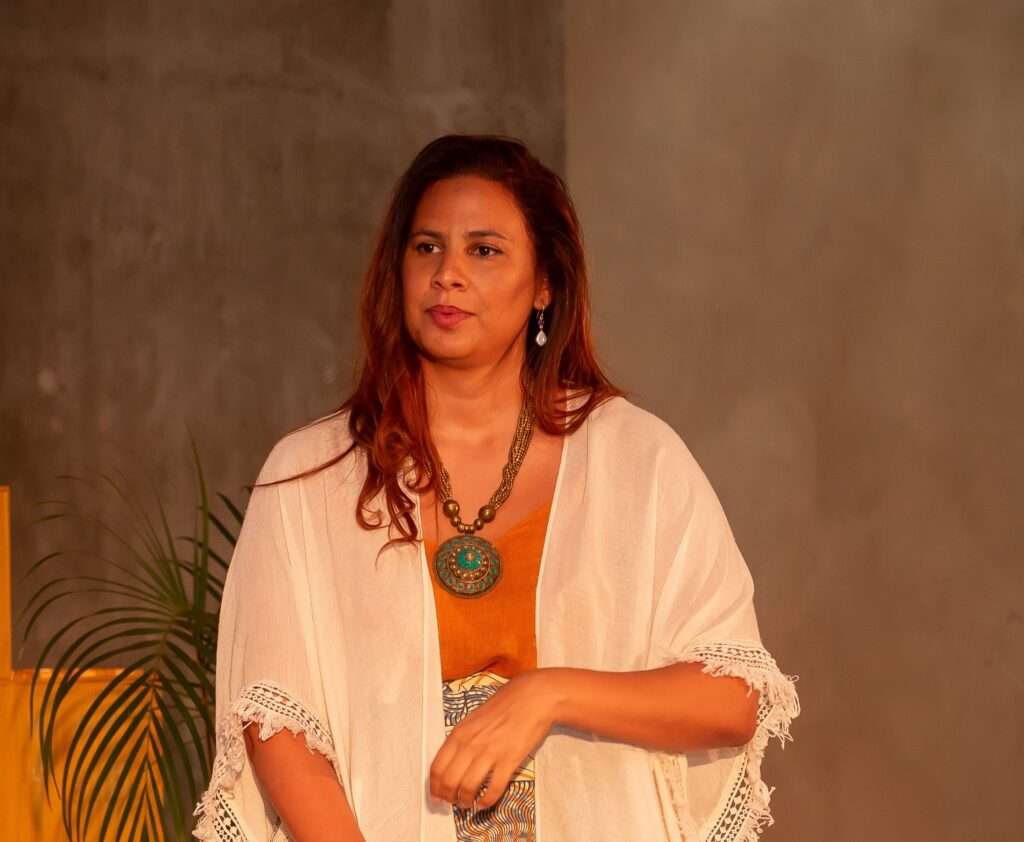
Sociologist and anthropologist Tassiana Tomé is the curator of the Maputo Fast Forward 2026 International Conference, which this year proposes a reflection on the impacts of digital technologies and artificial intelligence on contemporary society. Under the theme “Artificial Realities: The Infinite Mirror,” the conference intersects issues related to democracy, the environment, the economy, education, and artistic creation, seeking to place Mozambique and Africa at the center of a discussion that is increasingly global.
In this interview, Tassiana Tomé explains the ideas that underlie the conference and talks about the different “mirrors” through which the festival intends to look at technological transformations. From the relationship between artificial intelligence and democracy to the environmental costs of the digital world, passing through the future of work, artistic creation, and Africa’s place in the construction of future technologies, the curator defends the need to broaden the debate and question who is building and controlling the futures that these technologies make possible.
“Artificial Realities: The Infinite Mirror” is quite a provocative title. What, after all, is this artificial reality that the festival wants to present to the public? And why talk about a “mirror”?
When we talk about “Artificial Realities,” we are talking about a world in which new technologies, from digital platforms and algorithms to artificial intelligence, are progressively blurring the boundaries between the real and the artificial, between the lived and the simulated, between the organic and the synthetic, making them increasingly difficult to distinguish. We inhabit a time when these technologies already have the capacity to make autonomous decisions independent of human beings. They have ceased to be mere tools and have become a living environment, participating in, mediating, and conditioning what we see, think, consume, how we interact, and even how we imagine the future.
It is precisely here that the mirror comes in. The technological environment in which we are immersed also reflects the society that produces it. Technologies do not exist in a vacuum: they carry values, interests, prejudices, inequalities, and power relations. They can, therefore, reproduce and amplify structures that already exist. It is from this idea that the Conference is organized into different “mirrors,” each revealing a dimension of this transformation. The Political Mirror looks at the implications for democracy, governance, and public space; the Ecological Mirror questions the material and environmental costs of the digital world; and the Creative Mirror reflects on the transformations in artistic and cultural creation. But we will also have the Circles of Knowledge where debates on the future of education and work will be explored in depth.
Artificial Realities: Infinite Mirror seeks to place Mozambique and Africa within global reflections, not only as spaces where technologies developed in other contexts are applied or consumed, but as producers of knowledge, critical thinking, and technological imagination.
The conference intersects artificial intelligence, democracy, the environment, economics, and artistic creation. What unites these different dimensions, and what is the central question that runs through all the panels?
What unites these dimensions is the understanding that this technological revolution is profoundly changing the way we live. It is redistributing power and redefining our place as humanity. Artificial intelligence is transforming democracy and the circulation of information; it is altering the world of work and the economy; it is raising new questions for education and artistic creation; and it depends on a material infrastructure that has very concrete environmental costs.
Therefore, although the panels look at different areas, there is a cross-cutting question: who is building and controlling the futures that these technologies are making possible—and for whom? What problems in our Mozambican context and on the African continent are being amplified or created, but also what problems can we solve? What place do we occupy in the co-construction and imagination of the technological future, between optimistic possibilities and implications that could be catastrophic?
We also want to delve deeper into issues such as who controls the technology that is increasingly controlling parts of our lives? When an algorithm makes a decision about us, who is responsible for that decision? Is artificial intelligence democratizing knowledge or atrophying our cognitive abilities? What happens when we can no longer be sure that what we see or hear is true? What happens to democracy when technological tools have the power to capture electoral processes? And when a small group of giant technology corporations, the “Big Techs,” hold a monopoly of power and all our data?
There is an obvious concern in placing Africa at the center of the discussion about the technological future. What does it mean, concretely, to think about artificial intelligence and digital transformation from the perspective of Africa, and not just apply debates produced in other geographies to the continent?
It means, first and foremost, rejecting the idea that Africa is merely a place where technologies are consumed, tested, or applied, or where data is extracted. Today, global AI systems learn from datasets that barely represent the African experience, but their results shape African economies, education, and governance. What happens when the intelligence that defines the future is trained to ignore its history, its accents, its genius?
The continent has its own experiences, problems, knowledge, and ways of imagining the future that need to be part of the definition of these technologies and their regulation. The continent already has, for example, an Artificial Intelligence Strategy produced in 2024 by the African Union, but our place in major global discussions remains marginal. One of the invited speakers, Wakanyi Hoffman, works with inclusion. This implies asking, for example, what happens to our languages, our knowledge systems, our ways of producing and transmitting knowledge, our economies, and our territories when we adopt systems conceived in other contexts. However, it is undoubtedly necessary to recognize the existing asymmetrical power relations; control of infrastructures and key value flows remains concentrated in the Global North, and truly in a small number of “Tech” corporations.
Therefore, thinking from Africa is not just about “including an African voice” in a global conversation. It is about allowing African experiences and epistemologies to also question the assumptions of that conversation and help to imagine other futures. Kenyan Wakanyi Hoffman, one of the speakers at the Festival, for example, invites us to consider the importance of regulating AI, and of integrating principles of Ubuntu philosophy and ethics into AI development.
The choice of guests brings together philosophers, political scientists, activists, economists, artists, researchers, and journalists. What did you seek to provoke with this diversity of perspectives? Is there any clash of ideas that you consider particularly important for this conference?
Yes, the Conference, through its different “Panels – Mirrors,” addresses the different dimensions of this digital-computational revolution that affects all areas of our collective and individual lives, and therefore there is a need to bring together a plurality of disciplines and practices, from which we can more comprehensively question what is happening.
A philosopher can help us think about what it means to be human in a world where the organic and the synthetic merge; a political scientist can question the effects on democracy; an economist can look at the transformations in the labor market; an entrepreneur can share systemic innovations; an artist can show us what concepts sometimes fail to say; and so on.
We find it particularly important to bring into dialogue different perspectives that recognize the transformative potential of technology with those that compel us to look at its costs, exclusions, and risks. The conference does not intend to offer a single narrative about technology. We want to create conditions so that different futures can be imagined.
Panel 1 discusses the limits and possibilities of democracy in a digital space marked by algorithms, information manipulation, and surveillance. To what extent can technologies that should broaden participation, on the contrary, deepen inequalities and forms of control?
Technology can greatly expand participation: it allows for the creation of networks, the organization of movements, giving visibility to voices that previously had little access to public space, and creating new forms of mobilization and political activism.
But these same infrastructures can be used to monitor, manipulate, classify, and control, massively determining election results. Disinformation, bots, and deepfakes make it even more difficult to establish a common space of trust. And the impacts are not the same for everyone. Women and LGBTQIA+ people, for example, may be particularly exposed to forms of harassment, hate speech, and digital violence.
Therefore, the question is not simply whether technology is good or bad for democracy. The question is: who controls these infrastructures, with what rules, and with what consequences? And how can we ensure that the digital space remains a space for participation and not just a space for control?
Panel 2 introduces a dimension that is often hidden when we talk about artificial intelligence: its material and environmental costs. Why was it important to bring the ecological question to a conference on digital futures?
Because the digital is not immaterial. When we talk about artificial intelligence, for example, we tend to imagine algorithms, clouds, and screens, but behind that there are enormous infrastructures, energy consumption, data centers, minerals, water, and electronic waste. And this dimension is particularly important for Africa. The continent possesses a significant portion of the critical minerals needed for the digital economy and artificial intelligence, which raises questions about extraction, sovereignty, environmental justice, and value distribution. Therefore, we cannot talk about a digital future without asking which planet sustains this future and who pays its cost.
But the panel does not only intend to denounce impacts. We also want to discuss how technologies can contribute to responses to the climate crisis, to resource management, and to conservation. The question is how to build digital futures that remain habitable.
In the Creative Mirror, the discussion directly addresses the artists: artificial intelligence, generative systems, and algorithms are altering the very idea of authorship and creation. What is really at stake for African artists and cultures in this process?
Much more is at stake than the possibility of a machine producing an image, a piece of music, or a text. We are discussing who the author is, what it means to create, what originality is, and who has the right to the value produced by a work. If an artificial intelligence is trained with thousands of works by artists, for example, we need to discuss the rights, recognition, and remuneration of these creators.
But there is also a particularly important cultural question for Africa: who controls the representation of our histories, identities, and knowledge when algorithmic systems begin to participate in their production?
Technologies can open up extraordinary possibilities for African artists to experiment with new languages, work with extended reality, and reach new audiences. But they can also reproduce appropriations and erasures of knowledge and aesthetics that already have a long history.
Therefore, we want to think about technology not only as a threat to creation, but also to explore how the digital territory is being occupied and transformed by artists and cultural producers.
After four panels and the Knowledge Circles, what would they like the audience to take away? Does the conference only intend to create space for reflection or does it hope to contribute to concrete changes in the way we think about, use, and participate in the construction of technological futures?
I hope people take away more questions, but also more agency. Artificial Realities: Infinite Mirror: when we look at the mirrors that this technological environment is reflecting back to us through its screens, we are also looking at ourselves: at our inequalities, our desires, our fears, our values, and what we imagine to be possible.
If someone leaves the MFF wanting to continue the conversation, to ask a question they had never asked before, to create a collaboration, or simply to look at their own daily life and how they use technological tools, to learn about the innovations and solutions being created in Mozambique, then I think the Festival will have succeeded in fulfilling its purpose. And above all, I would like them to take away the hopeful idea that the future is not just something that will happen to us. It is also something we can contest, imagine, and build collectively.